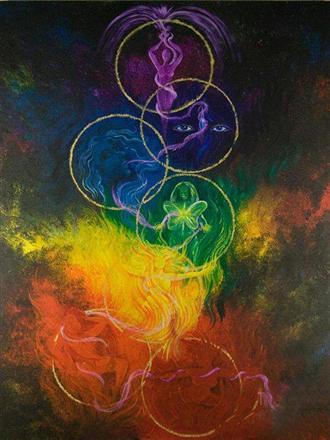
One needs to know the context of the myriad roads travelled by the ancient yogini; here’s a brief snapshot of her story. Let’s travel back in time to 3000 C.E. Based on archaeological findings and textual evidence during the Indus Valley Civilization, a woman was a vital presence in spiritual life, associated with fertility, growth, abundance, and prosperity. In her book, Yogini: The Power of Women in Yoga, Janica Gates states, “There are numerous references to female scholars, priestesses, and philosophers who were practicing Yoga in its widest sense, acknowledging the connection between the human and Divine.” Some of the hymns in the Rig Veda, the most ancient Veda, were penned by the rishikas, or the 27 women sages. Notable among these learned women was Lopamudra, who taught her husband. They were also trained musicians and singers, who sang and taught these hymns in forest universities, called Gurukul.
Women’s Roles in Society
With the decline of the Indus Valley Civilization came the fall of women’s status and their participation in religious life. A patriarchal Brahminical era began, in which the Laws of Manu, Manava Dharma, compiled around 200 BCE. According to Agi Wittich, author of Women In Post Colonial Modern Yoga:A Feminist Point of View and The Hebrew University of Jerusalem graduate student, the caste system prescribed men’s and women’s dharma, or specific roles and doctrines. Men had four stages of life (student, householder, elder, and ascetic), while women had only one: stridharma, or “female householder.” However, these laws were not universally accepted and practiced all over India, especially not by the South Indian Dravidian population or by rural and lower caste populations.
During the Classical Period of yoga, a woman’s position was predominantly mired to the men in her life. Her spiritual and intellectual life was connected to her expressions of chastity, loyalty, and values of self-sacrifice and devotion to the husband. However, texts and monuments from 1 and 2 C.E. point to some agency with women. Some were prominent landowners and upadhyis, “female religious teachers.” Still, during this time, most women didn’t actively or openly lead in spiritual matters. It’s imperative to note that the primary audience for the Sutras (the most widely used text for students of yoga) were young boys, and one has to keep this context in mind as we study them.
Women in Various Yoga Traditions
Around the same time, there was a more democratic, less ascetic, and severe tradition: tantra. In Tantra Yoga, Shakti (“the Divine Feminine”) is revered. Women were teachers and practiced freely, especially in the rural communities. These Tantric Yoginis rejected societal norms and defied the Brahmanical practices of the day. They were considered healers and thought to have siddhis (“supernatural powers”). Gates points out that closely related to the tantra tradition is the the Shakta tradition of ancient India, in which the Goddess is worshipped in all her forms, and many concepts of the feminine principle (prakriti, maya,and Shakti) come together. Tantra and Shakti traditions both helped revive the pre-patriarchal, pre-Brahminical values of feminine inclusion.
As a reaction to Hindu casteism and religious conversions from Muslim and Christian invasions, Bhakti Yoginis emerged around 1100 to 1700 C.E. Bhakti Yoga is first mentioned by Krishna in the Bhagavad Gita as an accessible way to access the Divine through love and devotion. This strong, vital presence in the yogic landscape seemed democratic and anti-hierarchical, opposing elaborate rituals, and stemming from the heart were more intuition centric. Female devotees thrived in this tradition. For instance, Akka Mahadevi and Mirabai defied powerful husbands in their steadfast devotion to Krishna and Shiva, respectively, and authored several lyrical compositions that are still sung today.
Women’s Revolution
By the mid 18th century, India was a British colony with many nationalists wanting independence. Thought leaders such as Swami Vivekananda influenced the cultivation of a physically strong and intellectually capable youth, aiming to overthrow their British rulers. Asana practice blended with other physical practices, such as wrestling, European gymnastics, acrobatics, etc. Madame Blavatsky, a controversial Russian occultist and co-founder of The Theosophical Society, penned several books on Vedas and Upanishads, which piqued Western minds and Eastern philosophy. Around the same time, Krishnamacharya (the father of modern-day yoga) accepted his first woman student: the Latvian-born Indra Devi, affectionately called Mataji.
From this period onward, many female visionary teachers (especially in the West) have deeply influenced our practice and knowledge of yoga. Bringing forth their own particular sensibilities and innovations, they reflect a shift in the larger world in regard to women’s rights and the changing landscape of what is yoga.
Written by Anjali Rao and published on breathetogetheryoga.com/yoga/understanding-womens-role-in-yoga-history
“The Divine Goddess. The Powerful Devi. Prakriti, That Which Is Manifested. The Mother of All Creation. The Sorceress. The Destroyer of Evil. The Seductress. The One Who Danced with The Lord. The Earth Mother. The Seen. The One Who Brought Yoga to the West. The Peacemaker. The Yogi-prenuer. The Yoga Teacher. The Yoga Student.”