
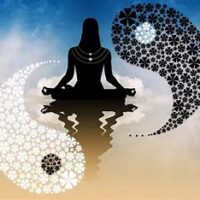
 Patterns define our lives. Look around you right now; look carefully and you will notice the patterns surrounding you. Look up; you will see things that are high. Look down; you will see things that are low. Listen; you will hear things close by, and you will hear things far away. You will hear loud or obvious noises. You may hear soft, subtle sounds. Bring your attention inward; you may feel the tip of your nose (especially now that you just read the words “tip of your nose”) or the top of your head. Now you may be feeling the tips of your toes. Up, down near, far louder, softer – these are just some of the adjectives we can choose to describe the patterns of life, of existence. All patterns are formed by contrasts. The pattern on a chessboard is formed by the contrast of dark and light. The pattern of your life, when reflected upon, has displayed a contrast of good times and bad. For the Daoist, harmony and health are created when conditions arise where the contrasting aspects are in balance.
Balancing is not a static act. Imagine the typical depiction of weighing scales: two plates held by a common string suspended at a point halfway between them. When two equally weighted objects are placed upon the scales, there is a slight swaying motion, like a pendulum. If one side is too heavy, the scales tip and balance is lost. When both sides are equal, there is still a slight oscillation around the middle position. This rebalancing is the returning to wholeness and health.
Like two sides of one coin, yin cannot exist without yang; yang cannot exist without yin. They complement each other. Since existence is never static, what is yin and what is yang are always in flux, always changing.
The observation that everything has yin or yang attributes was made many thousands of years ago in ancient China. The terms existed in Confucianism and in the earliest Daoist writings. The character yin refers to the shady side of a hill or stream. Yang refers to the sunny side. Shade cannot exist without light: light can only be light when contrasted to darkness. And so, we see how, even in the earliest uses of these terms, patterns are observed.
Darkness and light are just two of the many aspects separating yin and yang. Yin is used to describe things that are relatively denser, heavier, lower, more hidden, more yielding, more feminine, more mysterious, and more passive. Yang is used to describe the opposite conditions: things that are less dense, lighter, higher, more obvious or superficial, more masculine, and more dynamic.
Look again at the symbol for yin and yang; do you see the white dot within the dark swirl? Even within the darkness of yin, there is found a lightness of yang. And vice versa: within the white swirl is a black dot; within yang is always found yin. In the context of temperature, we say that hotter is yang and cooler is yin: but slightly hot is yin compared to extremely hot. And extremely hot is yin compared to hotter yet, which would be yang. In the other direction there is cool and there is cold. Yang would be cool relative the yin of cold.
In our yoga practice there are very active asana workouts, which we may call yang, but even within these relatively yang practices we can find relatively yin aspects; watching our breath mindfully while we flow through a vigorous vinyasa is just one example.
Just as we can detect yin elements within the yang aspects, we can also notice how yin becomes yang, and yang can transform into yin. These transformations may be slow and subtle, or they may be devastatingly quick. The seasons roll slowly by; they change imperceptibly. The yang of spring and summer transforms day by day into the yin of fall and winter. It is not possible to pick the exact moment at which one season becomes another, astronomical observations notwithstanding. But the transformation may also come quickly: the eye of a hurricane quickly brings calm, and just as quickly the eye moves on and the other half of the storm strikes.
In our own life we often experience both the slow transformations of yin into yang, and yang into yin, and the quick changes. We wake up in the morning; yin becomes yang. Sometimes our awakening is slow, leisurely; this is a slow transformation. Sometimes we wake with a start and jump out of bed, perhaps because we realized we overslept. When we work long hours for many weeks or months in a row (a very yang lifestyle), our body may seek balance by suddenly making us too sick to work (a very yin lifestyle), or it may gift us with a severe migraine to slow us down. Yang is quickly transformed into yin.
In this last example, we can see that if we stay too long in an unbalanced situation, the universe acts to restore balance. It throws us to the other side: our health may suffer; our lives may change. If we do not heed the need for balancing yin and yang, this transition can be devastating; a heart attack could be the balancing force applied to us. These imbalances are often referred to as either a “deficiency” or an “excess.” We can have an excess of yin or a yin deficiency; we can have an excess of yang or a yang deficiency. The cure is to apply the opposite energy to control the excess or deficiency: to pursue a lifestyle which is reflective of this need for balance.
Published on https://yinyoga.com/


